For the year before, the years during, and the first years after the degree

The bridge between knowing and proving.

The Learner’s Discerning Practice Model (hereafter, the Discerning Practice Model) is a five-practice operating system for master's students, and the managers on either side of the degree. It produces a dated record, in your own words, of how your judgment actually changed. That record is the part that holds up when the AI is taken away.

Five practices. On cadence. One record.
For the year before, the years during, and the first years after the degree

The Learner’s Discerning Practice Model (hereafter, the Discerning Practice Model) is a five-practice operating system for master's students, and the managers on either side of the degree. It produces a dated record, in your own words, of how your judgment actually changed. That record is the part that holds up when the AI is taken away.

Published In
01 The Friday Synthesis

Fifteen minutes on Friday. Four questions. Your own words.


A free weekly writing practice by email, for the year before, the years during, and the first years after the degree.

The week is over. The assignment is in. The thesis file is still empty, and you cannot say in one sentence what the week taught you.

The Friday Synthesis is fifteen minutes that fixes that. Four questions, every Friday, by email. You write four short paragraphs in your own words and keep them with the date. Nine of them are thesis material. Twenty of them are the answer to "what did the degree change about how you work."

Is this for you

  • You work full time and study at night.
  • Your thesis has a title and nothing under it yet.
  • You use AI for coursework and quietly wonder what you kept.
  • You finished recently and the structure ended at the ceremony.
  • You have a degree ahead of you and want a baseline before it starts.

What arrives on Friday

One email at 07:00 GMT+7. The same four questions, one sentence from my own week, and one request: reply with one line from what you wrote. Any time before Sunday night counts. No course, no lessons, no chasing. Join any Friday.

  1. What happened this week.
  2. What assumption did I make that turned out wrong.
  3. What general principle does this illustrate.
  4. Where would this principle mislead me.

Write it yourself. Do not ask an AI assistant to draft it. The value is in your own words, under real time pressure, about the week you actually lived.

Fifteen minutes is the way in. The full practice is thirty, and the model page explains why. Start with fifteen.

The questions never change. What changes is that Friday comes again, and a short note from my week arrives with it. You are not waiting for new questions. You are keeping an appointment.

Who is writing to you

  • Thirty years of commercial leadership across Vietnam, Cambodia, and Myanmar.
  • Eight years teaching senior managers across nine Executive MBA cohorts at CFVG.
  • MD (Hue, 1991), MBA with Distinction (Maastricht, 2008), PhD in Management (Paris 1 Panthéon-Sorbonne and ESCP, 2017).
  • Published on this subject in University World News and AACSB Insights in 2026.

Bạn có thể viết bằng tiếng Việt. Bốn câu hỏi giống nhau mỗi tuần, mười lăm phút, bằng lời của chính bạn. Miễn phí.

Start today.

Do not wait for Friday. Write the first one on the week just gone, ten minutes, then reply to the confirmation email with one line from it. The practice is free and stays free.

Unsubscribe with one click in any email. Your address is used only for what you tick here. Privacy note.

02 About

Three credentials, one perspective.


A country manager who writes down what he got wrong, and shows working people how to do the same, before, during, and after a graduate degree.

For most working managers, and for most master's students bridging study and work, the gap is not knowledge. The gap is the system that connects what they know to what they produce.

The major frameworks of professional development have shaped scholarly understanding for more than forty years. Kolb's experiential learning cycle (1984) describes how learners convert experience into knowledge. Argyris and Schön's organizational learning theory (1978) distinguishes the surface-level adjustment of single-loop learning from the deeper assumption-shifting of double-loop learning. Mezirow's transformative learning theory (1991) explains how mental frames change. Mintzberg's model of managing (2009) offers a comprehensive picture of what real managers actually do. These frameworks rarely show up on a Monday morning when a working manager, in a program or a year out of one, has to make a real decision under real constraints.

Dr. Phuong Nguyen has spent thirty years inside exactly those decisions. He has built and led country teams across Vietnam, Cambodia, and Myanmar, including fifteen years at Johnson & Johnson. He has launched and relaunched brands that became market leaders across the region. He coaches his managers at work, and most of what he knows about learning comes from watching what they keep and what they lose. Alongside the P&L, he earned a Six Sigma Green Belt at Johnson & Johnson, developed as a marketing excellence trainer, and completed the Korn Ferry leadership programs that shaped a generation of Asian managers.

In parallel, he has spent six years inside doctoral seminars in Paris and Vietnam, and, as a Visiting Lecturer at CFVG, eight years observing senior managers across nine Executive MBA cohorts. The Discerning Practice Model emerged from that intersection: a recognition that people inside the arc of a graduate degree live a fragmented dual-track life, and that the integration of academic study and professional work, structurally promised by graduate education, rarely happens automatically.

The Discerning Practice Model is what survived. It is the practice, distilled.

1991
MD
Hue University of Medicine and Pharmacy
Trained to read evidence, weigh consequence, act under uncertainty.
2008
MBA with Distinction
Maastricht School of Management, Netherlands
Trained to lead organizations, read markets, build commercial systems.
2017
PhD in Management
Université Paris 1 Panthéon-Sorbonne · ESCP Business School
Trained to interrogate assumptions, construct theory, defend reasoning.
03 The Discerning Practice Model

Five practices. One cadence. A dated record AI cannot replicate.


An operating system for the dual-track life of the year before, the years during, and the first years after the degree.

Graduate education's structural promise, that academic study and professional work reinforce each other, rarely happens automatically. The Discerning Practice Model addresses this directly. It is not a curriculum, not an assessment framework, and not a learning theory. It is five practices, done on cadence, that produce a dated record, in your own words, of how your judgment actually changed.

Each practice produces an artifact you keep. The artifacts compound across the program into a longitudinal record of how your judgment has evolved, in your own words, with dates attached. A year in, you have something to show that no AI tool, no employer reference, and no transcript can substitute for.

AI-resistant by construction

The practices are deliberately structured around cognitive work that AI cannot perform on your behalf: writing from memory, predictions before consultation, principles in your own words with explicit boundaries. AI used well alongside the practices accelerates learning. AI used to replace them destroys their value.

Designed for two to three hours per week

The practices fit a working week, whether the degree is ahead of you, under way, or behind you. They replace less-disciplined versions of activities you are already doing rather than adding new ones. The discipline is the cadence, not the volume.

1 EXPERIENCE Engage with challenge 2 SYNTHESIZE Connect what you know 3 APPLY Test under pressure 4 FRAME Articulate principles 5 GROW Develop mastery

Each practice builds on the last. The artifacts compound. The record is dated, attributable, and AI cannot fabricate it.

Begin with the second practice: the Friday Synthesis, free by email

See the five practices
…whether it is producing graduates whose judgement holds up when the model is taken away, or graduates whose surface competence collapses without it.
86%
of employers surveyed expect AI
to transform their business by 2030
World Economic Forum
Future of Jobs Report 2025
Why this matters now

The credential is no longer enough. Neither is the AI assistant in your browser.

Generative AI now produces work that looks adequate but builds no durable capability. A 2025 study of university students randomly assigned to learn with or without ChatGPT found that the AI-assisted group improved essay scores but showed no greater knowledge gain. The authors named the pattern metacognitive laziness: students outsourced the planning, monitoring, and evaluation phases of learning to the tool rather than scaffolding their own thinking with it.

The Discerning Practice Model is built precisely for the cognitive work AI cannot perform on your behalf: writing from memory, predictions before consultation, principles in your own words with explicit boundaries. Used well alongside the practices, AI accelerates learning. Used to replace them, it produces surface adequacy without judgment.

The practices are the part that compounds. AI is not.

04 The Five Practices

Experience. Synthesize. Apply. Frame. Grow.


A short introduction to each of the five practices that make up the Discerning Practice Model. Total time commitment at full intensity is roughly two to three hours per week, replacing less-disciplined versions of activities you are already doing rather than adding new ones.

Experience icon
Practice 01
The Stretch Inventory
The Experience practice
Monthly · 15 minutes

A single page capturing what you are taking on, at work and in any coursework, and what you are avoiding. Avoidance patterns reveal where capability is eroding.

What am I avoiding, and what is the avoidance protecting me from learning?
Synthesize icon
Practice 02
The Friday Synthesis
The Synthesize practice
Every Friday · 15 minutes

Four written prompts in prose. What happened this week. What assumption did I make that turned out wrong. What general principle does this illustrate. Where would this principle mislead me. The fourth prompt, the boundary statement, distinguishes a real principle from a slogan.

Where would this week's principle mislead me, if I held it too tightly?

Start this practice free, by email, every Friday

Apply icon
Practice 03
The Decision Hypothesis
The Apply practice
Before any meaningful decision

Four lines on an index card: the decision, what I expect to happen, what evidence would falsify my expectation, the date I will check back. The check-back date is non-negotiable. Without it, the prediction is hope, not hypothesis.

What evidence would falsify my expectation, and when will I look for it?
Frame icon
Practice 04
The Operating Manual
The Frame practice
Revised once per academic term

Two to three pages of the principles you actually operate by, each paired with the situation where the principle would mislead you. The diff between revisions is the visible record of what the program is changing.

What's the principle I would write but won't, because writing it would commit me to changes I'm not ready to make?
Grow icon
Practice 05
The Annual Capability Inventory
The Grow practice
Once a year · 15 minutes

Three honest questions. What can I now do better than a year ago. What can I still not do that I should. What am I doing on tenure rather than on growth. The third question is the one most often skipped, and the one that distinguishes development from credentialing.

Am I being given new things to do, or the same things in larger versions?

Four key questions, asked across the four phases of the journey

The five practices are constant. The questions they answer change with the phase of the journey: before the program, during coursework, during the thesis, and, cutting across all three, the resonance between study and work. Before the program begins: what do I currently believe and how do I currently decide, before the program begins to overwrite me? During coursework: of what I am studying this week, what will I have actually changed about how I work in three months? During the thesis or capstone: what does my dated record of the past year reveal that no literature search will? Continuously, across the dual-track life: where, this week, did the classroom and the workplace teach me different things about the same problem, and which was right?

The artifacts accumulate. A year in, you have a dated record, in your own words, of how your judgment actually changed. By mid-career, that same record has become the strongest evidence the manager has of their own developed judgment.

The jump, in other words, is not a gift. It is a practice. Priors have been built.
05 Training & Development Lineage

What this practice is built on.


The Discerning Practice Model stands on three foundations: thirty years of country leadership, nine cohorts of classroom observation, and the adult-learning tradition cited throughout this site. The programs listed here are not its source. They are where the gap between attending a program and practicing a discipline first became visible, firsthand, from inside the room. What the model extracts from each is the repeatable practice the event itself could not sustain. The practices were built where the work happens.

People Management & Leadership

2016
Leadership Development Program, Korn Ferry

Built specifically for senior Asian executives transitioning into country and regional leadership. Strengths-based assessment, executive coaching, and developing leadership presence in cross-cultural commercial environments. Influenced the Operating Manual practice, particularly the discipline of articulating principles in your own words rather than borrowing them.

2014
Asian Leadership Forum with Executive Coaching, Korn Ferry

Forty hours of executive coaching paired with a peer cohort of senior Asia-Pacific leaders. The most direct influence on the Annual Capability Inventory. The Korn Ferry methodology insists on distinguishing capability development from career advancement, the central question of the inventory.

2006
Marketing Competency Models, Johnson & Johnson

The structured framework J&J used to define what a marketing professional should be able to do at each career stage, not what they should know. The competency-not-knowledge distinction is the spine of the entire model.

2005
Management Fundamentals II, Johnson & Johnson and Ken Blanchard

The advanced module of the Blanchard partnership program. Situational leadership, performance conversations, and feedback that creates change rather than defensiveness. Influenced the Friday Synthesis practice, particularly the requirement to write the boundary statement, where would this principle mislead me, not just what worked.

2004
Management Fundamentals I, Johnson & Johnson and Ken Blanchard

Basic management discipline: setting direction, structuring meetings, allocating time, building trust. Most managers never learn this formally. Most never need to, and that is precisely why mid-career plateaus happen so reliably.

Management & Process Excellence

2006
Six Sigma Green Belt, Johnson & Johnson

Certification earned through an actual process improvement project at Janssen-Cilag Vietnam, not a classroom exercise. The DMAIC discipline (Define, Measure, Analyze, Improve, Control) is the structural ancestor of the Decision Hypothesis. The insistence on measurable predictions and post-implementation review is identical.

2004
Process Excellence Training, Johnson & Johnson

The full process excellence curriculum: Six Sigma analytical rigor, Lean's discipline of removing what does not create value, and Design Excellence's principle that quality must be designed in, not inspected in. Together, these taught the most important meta-lesson behind the model: structured practice produces better outcomes than talent operating without structure.

How the lineage shows up in the model

Every practice in the Discerning Practice Model is the distilled, simplified, generalized version of something Dr. Nguyen first encountered in formal training and then applied across hundreds of real management decisions.

The Friday Synthesis is not the Ken Blanchard reflection model, but it would not exist without it. The Decision Hypothesis is not Six Sigma DMAIC, but it would not exist without it. The Operating Manual is not the Korn Ferry leadership philosophy exercise, but it shares its DNA. The Stretch Inventory carries the J&J Marketing Competency Models inside it.

What the model does is take the irreducible core of each, the smallest repeatable practice that produces the developmental outcome the original program was trying to create, and deliver it as a habit a working manager can actually maintain on a Friday afternoon, in a program or out of one.

06 Roadmaps

Four applications of the model across career stages.


The Discerning Practice Model's primary application is the arc of a graduate degree: the year before, the years during, and the first years after. The same five practices carry across it. Each roadmap walks through the practices for a specific professional context.

For Working Master's Students

From credential to dated record of judgment.

The challenge:You are pursuing an MBA or specialized master's while working full time. The program promises that academic study and professional work will reinforce each other, but the integration is not happening automatically. The risk is that you graduate with a credential and no evidence that your judgment has actually changed.

For Mid-Career Managers

From execution to strategic positioning.

The challenge:You have years of execution experience. You can do the work. The next move requires you to demonstrate strategic thinking, not just describe it.

For Commercial Leaders

Building the organization, not just the business.

The challenge:You are running, or about to run, a commercial unit with a P&L. The gap is between running the business and building the organization that will run the business after you.

For Managers Building Organizational Capability

Modeling the practice for a team.

The challenge:You are responsible for a team's collective development, as a country head, function leader, or HR partner. The practices are private disciplines, kept by each person for their own benefit; they cannot be installed by mandate. What a leader can do is model the cadence visibly, protect the time it requires, and keep every artifact private: never inspected, never required, never graded.

The roadmaps are introduced briefly here; the five practices above are the same in every seat.
07 Research & Publications

Current work on professional learning in the age of generative AI, and peer-reviewed research in marketing, consumer behavior, and management theory.


Current work: professional learning in the age of generative AI

2026 The Learner’s Discerning Practice Model: Reflection Answerable to Action for Working Master’s Students in the Age of Generative AI. Preprint, EdArXiv, September 2026 (DOI pending). Submitted to a peer-reviewed journal.
2026 The leap AI can’t make is what graduate programmes don’t teach. University World News, 25 August 2026.
2026 Graduate programmes have an AI problem they aren’t naming. University World News, 6 May 2026.
2026 Moving From Skills to Capabilities. AACSB Insights, 20 July 2026.

Doctoral and earlier research

Doctoral Research

2017 Immersing the Lay Self into Medication Reasoning: A Theory of Parental Health Behavior in the Context of Asian Developing Countries. Doctoral dissertation, Université Paris 1 Panthéon-Sorbonne. Advisor: Prof. Jacqueline Fendt, ESCP Europe & Ecole Polytechnique.

Editorial Service

Reviewer, International Journal of Pharmaceutical and Healthcare Marketing (2022–Present)

Peer-Reviewed Journal Articles

2013 Mothers' Perceived Vulnerability, Perceived Threat, and Intention to Administer Preventive Medication to Their Children. Contemporary Management Research, 9(4), 399–418.
2012 Vietnamese Consumer Behavior toward Children's Over-the-Counter Medications: A Reasoned Action Approach. Journal of International Business Research, 11(3), 89–104.
2012 The Relationship between Past Use and Medicating Intention within the Theory of Planned Behavior. Review of Integrative Business & Economics Research, 1(1), 385–402.

Selected Conference Papers

2026 What Can Gen-AI Code? Reflective and Formative Indicators in Classic Grounded Theory. Grounded Theory Futures 2026, online. Accepted for presentation, 23 September 2026.
2018 Parental Lay Self Immersion into Expert Communities of Child Health. 35th Annual Qualitative Analysis Conference, Canada.
2014 Fendt, J., & Nguyen, P. Parents' OTC Medication Behavior with Their Children. British Academy of Management Conference, Belfast.

Thesis Supervision

As Thesis Advisor at CFVG School of Management, Dr. Nguyen has guided MBA candidates through to successful defense across a range of topics in healthcare marketing, consumer behavior, and service quality:

2024Marketing mix criteria for prescribing pharmaceuticals in Vietnam
2024Barriers to telemedicine adoption in Vietnam
2023Medication adherence among chronic heart failure patients
2023Influencer marketing platform effectiveness
2022B2B client satisfaction in international contexts
2021Determinants of pharmacy repurchase intention
2019Service quality in independent pharmacies
2019Inpatient experience measurement (Picker Problem Score)
Institutions face a real risk when they keep emphasizing the skills the labor market increasingly signals it does not need while they fail to build the capabilities that employers want.
08 Teaching & Speaking

Eight years inside the CFVG Executive MBA program.


Visiting Lecturer, CFVG, Ho Chi Minh City

Centre Franco-Vietnamien de Formation à la Gestion · May 2017 to Present

Eight years observing senior managers across nine Executive MBA cohorts, and one of the school's longest-serving visiting lecturers. Also serves as Thesis Advisor and Thesis Defense Examiner in the MBA Program.

What the cohorts asked for, in their own evaluations: across eight course evaluations from 2017 to 2025, 118 of 127 respondents rated the balance of theory and practice as right. Of roughly 300 open-text responses, two asked for more theory. Every other request for change asked for more applied work, or more time to do it in. The Discerning Practice Model is built on that request.

Content Marketing
Elective · 2021–Present
Marketing
Co-Instruction · 2020–Present
Consumer Insights
Elective · 2017–2021
Brand Management
Power Positioning · MMSS

Speaking topics

Audiences include MBA and specialized master's programs, corporate leadership teams, professional associations, and industry conferences across Asia-Pacific.

The Discerning Practice Model, full keynote
For program directors: closing the credential-to-capability gap
For graduate students: making the most of the dual-track life
AI in graduate education: discipline, not just feature
For executives: deciding what not to delegate to AI
The strategy-to-execution gap in commercial leadership
Consumer behavior in healthcare markets
Inquire about a speaking engagement
09 Reflections

Notes at the intersection of theory and practice.


Six reflections, drawn from across the five content pillars below. Grounded in classroom observation across nine cohorts at CFVG, in three decades of country leadership, and in the recent empirical literature on AI in graduate education. Freely available to read.

The model in practice

Practice-by-practice walkthroughs, worked examples, common failure patterns.

Career development

What the Discerning Practice Model changes for master's students, and the managers on either side of the degree.

Teaching

What nine cohorts of working professionals at CFVG taught the practitioner.

Management theory

Mintzberg, Kolb, Mezirow, Argyris and Schön, Senge, Drucker.

Field notes from the AI moment

What credentials and AI tools cannot replace, and why the practices are AI-resistant by construction.

REFLECTION 01 The model in practice

Why your strategic thinking is invisible, and what to do about it

There is a moment, somewhere around the seventh or eighth year of a serious career, when a person realizes that the people deciding their future cannot actually see what they are good at.

The decision they are good at making, the situation they read accurately, the pattern they recognized three weeks before anyone else. None of it is visible to the senior leader making the next promotion decision. None of it is visible to the program director writing the recommendation letter. None of it is visible to the future self who will, ten years on, try to remember what they used to know.

The gap is not in their thinking. The gap is in the documentation of it.

Senior leaders decide who is strategic based on what they can see. What they can see is what you have committed to paper. A written recommendation. A clear memo. A one-page argument. A documented decision with the reasoning attached. If your strategic thinking lives only inside your head and inside meetings, it is, from the outside, indistinguishable from its absence.

This is not unfair. It is unavoidable.

A leader making a promotion decision cannot inspect the inside of your mind. They can only inspect the artifacts your mind has produced. The manager who thinks brilliantly in conversation and writes nothing down is, from the outside, identical to the manager who does not think brilliantly at all. The graduate student who reasons her way through a hard case in the discussion section, but whose written work is generic, will be remembered, fairly or not, as a generic student.

After eight years standing in front of Executive MBA classrooms at CFVG, watching nine cohorts of working professionals move through the program, this is the part I believe more deeply than before. They arrived with sharp market instinct and years of hard-earned experience. Many had every reason to trust their judgment. But experience alone rarely creates structure. And strategy is not the quality of an idea. It is the discipline of making that idea usable by other people, and by your own future self.

The five practices of the Discerning Practice Model exist for one reason: to make the thinking you already do legible to the people who will decide what you get to do next, and to the version of you who will inherit your present judgment six months from now. The Decision Hypothesis preserves what you predicted and when. The Operating Manual preserves how you actually decide. The Friday Synthesis preserves how you process a week.

None of these practices makes you a better thinker. They make the thinking you already do legible.

The hardest part is that the practices feel slow. Writing a Decision Hypothesis takes longer than just deciding. Writing a Friday Synthesis takes longer than just remembering the week. The slowness is not a side effect of the method. It is the method.

Speed is what you optimize for when execution is the constraint.

Visibility is what you optimize for when judgment is the constraint.

By mid-career, the constraint has changed. Most managers, and most working master's students, are still optimizing for the wrong one, and wondering why their careers have stopped moving, or why their thesis supervisor cannot quite see what they are working on.

I have promoted managers whose thinking I had no direct evidence of, on the strength of a single clearly written memo. I have also failed to promote excellent thinkers whose thinking never reached the page. The first kind of mistake is recoverable; better evidence usually surfaces later. The second is not. By the time the thinking would have appeared, the decision has been made.

If you have ever wondered whether your work is being seen, start there. The work is being seen.

The thinking is not.

← Back to all reflections Dr. Phuong Nguyen

The weekly practice I teach my students and coach my managers is free at drpnguyen.com.

REFLECTION 02 Career development

The plateau is not a knowledge problem

Dr. Phuong Nguyen on the slopes of La Parva, Chile

La Parva · Chile · May 2008

There is a photograph of me from May 2008, on the slopes of La Parva in Chile.

In the photograph, I am holding ski poles. The light is good. The pose is confident. Anyone looking at the image would assume the man in it knew what he was doing.

I had read the equipment manual the night before. I had quietly watched the beginner instructors that morning. I had skied perhaps fifty meters before the photograph was taken.

What makes me smile about that photo now, almost twenty years later, is what the photo did not keep. It did not keep the wobbliness. It did not keep the quiet conversation I had with myself about being forty-one and starting something I did not yet do well. Photographs preserve confidence. They do not preserve the practice that produced it, or the practice that was still missing.

I think about that photo often when I talk to mid-career professionals about plateaus.

Most professionals who plateau in their thirties or forties believe they need more knowledge to move forward. So they enroll in another course. They read another book. They earn another certification, or another degree. The plateau remains.

This is the central misdiagnosis of mid-career stagnation. And it is the same misdiagnosis I see in working master's students who finish their first year of an Executive MBA and quietly notice, when no one is watching, that the framework they can recite has not yet changed how they made yesterday's decision at work.

The plateau is rarely a knowledge problem. It is a practice problem.

The habits that built your early career (execution speed, technical fluency, willingness to work hard) are not the habits that build judgment. Early-career success rewards doing more of what is asked. The next stage, whether you reach it through promotion or through a graduate program, rewards a different question: doing what is asked, while simultaneously building the judgment that allows you to be asked harder things.

Most professional development is event-based. You attend the workshop, return to your desk, and, in my observation, most of what you learned is gone within a few months. The same pattern shows up in graduate education. You finish the course, hand in the assignment, and the work makes no observable change to how you operate on Monday morning. The pattern has been documented in the experiential learning literature for more than forty years. It is universal. It is the reason most professional development, including most graduate education, produces less than it promises.

The Discerning Practice Model replaces events with practices.

A practice is not a lesson. It is a short, fixed, repeated activity done on a known cadence. Fifteen minutes once a month for the Stretch Inventory. Fifteen minutes every Friday for the Friday Synthesis, thirty when you have them. Four lines on a card before any meaningful decision. None of this is heroic. All of it is compounding.

The truest part of growth, I have come to believe, begins from steps that are still wobbly. The early-career professional who installs these practices builds the foundation the mid-career version of themselves will need. The graduate student who installs them in their first term has, by the time of the thesis, a year of dated material no other student in the cohort can produce. The mid-career manager who installs them late begins, finally, to grow again at a stage where many peers have stopped.

A book is something you finish.

A practice is something you keep.

The careers that compound, and the degrees that change the people who earn them, belong to the ones who have understood the difference.

← Back to all reflections Dr. Phuong Nguyen

The weekly practice I teach my students and coach my managers is free at drpnguyen.com.

REFLECTION 03 Teaching

What I learned, eight years and nine cohorts later, that I could not have learned any other way

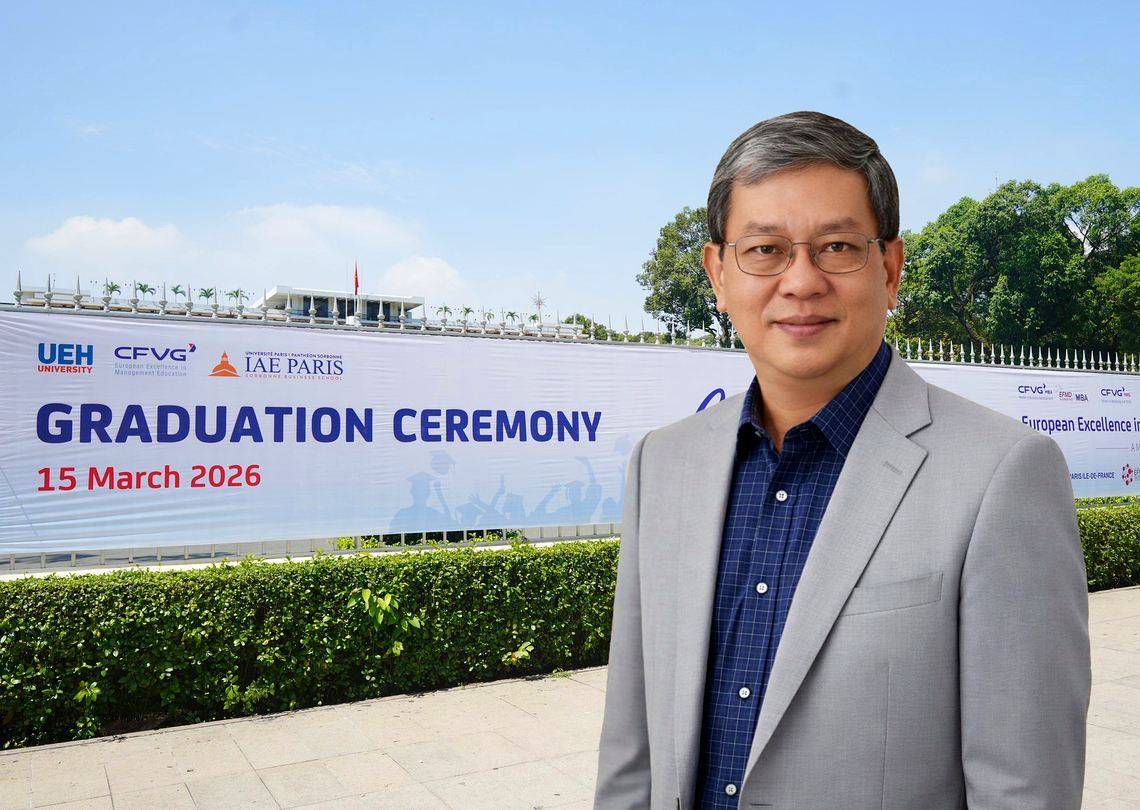
Dr. Phuong Nguyen at the CFVG Graduation Ceremony, Ho Chi Minh City, March 2026

CFVG Graduation Ceremony · Ho Chi Minh City · 15 March 2026

The photograph is from the CFVG Graduation Ceremony on 15 March 2026, in Ho Chi Minh City. I had stood through eight of these by then, including a few I remember more vividly than others. This was the ninth.

When I first walked into a CFVG classroom in May 2017, I thought I knew why I was there. I had more than two decades of country leadership behind me. I had launched brands, run P&Ls, built and rebuilt teams across Vietnam, Cambodia, and Myanmar. I assumed I was being asked to bring that experience into the room, a practitioner among scholars translating frameworks into the specifics of the local market.

That was not what teaching turned out to be.

What teaching turned out to be was watching, with care, while a particular kind of failure happened, again and again, to people who had every reason not to fail. The students who came to CFVG were not novices. They were senior managers, country heads, finance directors, people with fifteen and twenty years of operating experience. They could read a case. They could recognize a framework. They could explain, in the discussion section, exactly what Mintzberg or Kotler or Porter would say about the situation in front of them.

And then, the following week, they would describe a real decision they had made at work, and the framework would have left no trace.

Not because they had forgotten it. They could still recite it on demand. The framework simply had not been available to them at the moment of decision. It lived in the seminar room and not in the office. By Monday morning, they were operating from the same instincts they had walked in with.

I had thought, at first, that this was a problem of individuals. Some students were better at integration than others, and the rest needed time. After the third cohort, I began to suspect it was not about the individuals. After the fifth, I was certain. The pattern was too consistent. The same brilliant managers, with no obvious deficit of intelligence or motivation, were producing the same gap between framework recognition and framework operationalization.

It was not a problem of individuals. It was a problem of method.

The graduate education we were giving them (the lectures, the cases, the readings, the exams) was almost perfectly designed to produce framework recognition. It was almost perfectly silent on framework operationalization. We were assessing what was easy to assess, and assuming the harder thing would happen on its own. It did not happen on its own. The credential was being conferred on a transformation that was, in many cases, not actually taking place.

What we now call the Discerning Practice Model is the answer those nine cohorts taught me to construct. The Friday Synthesis. The Decision Hypothesis. The Operating Manual. The five practices were not invented. They were reverse-engineered from the gap between what the program promised to do and what, year after year, it was actually doing.

Standing in front of the graduation banner on 15 March 2026, I watched the most recent cohort take their seats, and I understood graduation differently than I had at the first ceremony. Graduation is not the moment a credential is conferred. Graduation, when the work has been discerning practice, is the moment a person walks out of the program with a dated record, in their own words, of how their judgment actually changed.

Most graduations are not that.

The work of the next decade is to make more of them so.

← Back to all reflections Dr. Phuong Nguyen

The weekly practice I teach my students and coach my managers is free at drpnguyen.com.

REFLECTION 04 The model in practice

The Friday afternoon nobody planned for

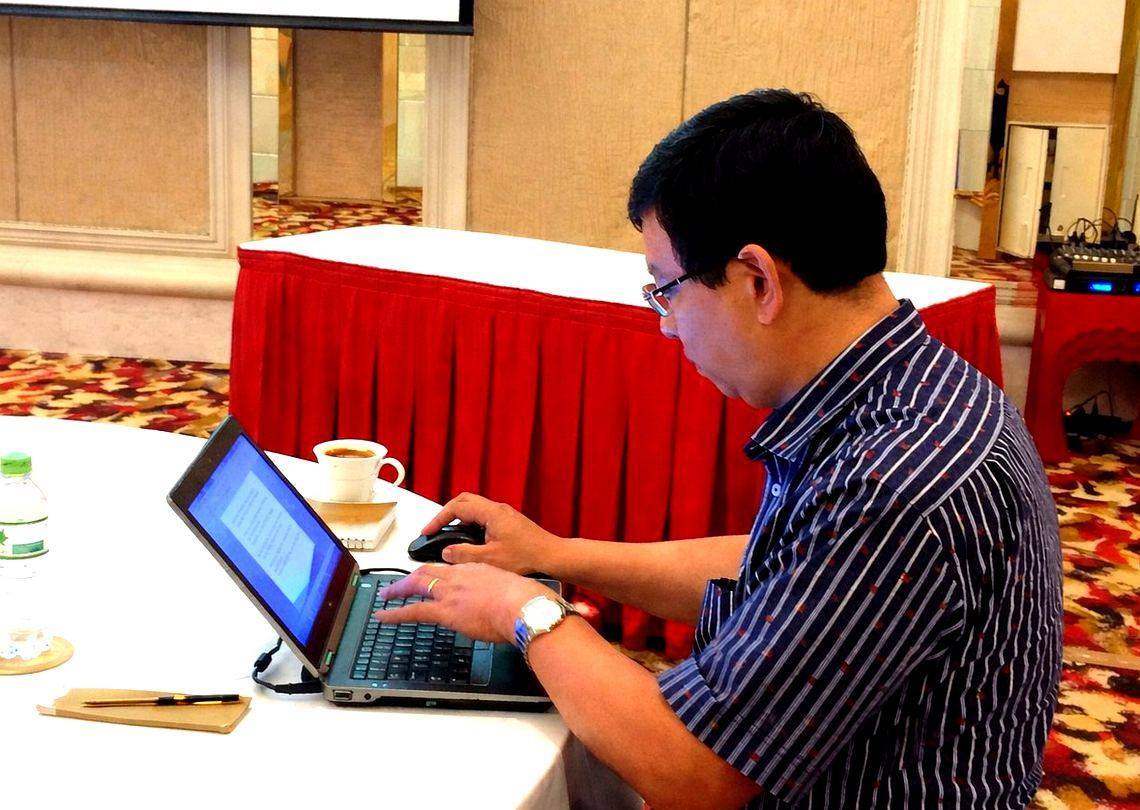
Dr. Phuong Nguyen working on a laptop at a hotel function room, between conference sessions

Between sessions, working through a synthesis · Vietnam

It is the second day of a two-day conference in a hotel ballroom in the south of Vietnam, and it is twenty minutes before the afternoon sessions resume. The room is empty. The staff are in the back, resetting microphones. My coffee has gone half cold. My notebook sits closed beside the laptop, with the pen across it.

The synthesis is overdue by a day. I had meant to write it yesterday. I will write it now.

I open the document. The cursor blinks.

The first three prompts are not the hard ones. What happened this week, I can write quickly: there were two long meetings about a brand we are repositioning, a difficult conversation with a senior team member, and a decision I had to make on Tuesday that I am still not sure was the right one. What assumption did I make that turned out wrong, I can also write, though more slowly. The Tuesday decision was the one. I had assumed the team would resist the change. They did not resist. They were quietly relieved, which means I had been carrying a story about them that was not accurate, possibly for months.

What general principle does this illustrate. I write a sentence I have written before, in slightly different words, three or four times across the previous Fridays. Resistance is sometimes a story the leader is telling, not a property of the team.

I look at the sentence for a moment. It is true. It is also the kind of true sentence that, by itself, will not change anything I do on Monday morning.

The fourth prompt is sitting there, and it is the one I want to skip.

Where would this principle mislead me.

This is the prompt that takes the longest. It is also the prompt I have, a few times in earlier weeks, written something glib for, just to get to the end of the document. It would mislead me if I assumed teams never resist, I might write, which is the kind of sentence that satisfies the form of the practice without satisfying its purpose. The boundary statement is supposed to be the point at which the principle stops being a slogan and becomes usable, and a glib boundary statement leaves the principle a slogan.

So I sit with it for a minute. Then I write something more honest. This principle would mislead me with the team I worked with three years ago, where the resistance was real, sustained, and rooted in their own correct read of a situation I had misjudged. If I generalize from this Tuesday, I will start hearing relief where there is, in fact, careful disagreement.

I look up. The staff are setting the front of the room. Two delegates have wandered back in. I have about four minutes. I save the document with the date in the filename, close the laptop, and slide it into my bag.

I know two things about this synthesis that I did not know fifteen minutes ago. I know that I have been carrying an inaccurate story about my current team. And I know the conditions under which the new principle I just wrote would betray me. Neither of those would have surfaced if I had spent the same fifteen minutes scrolling through email or lingering over the empty coffee.

The practice is not always done at the desk where it should be done. It is done in hotel function rooms. It is done in airport lounges. It is done on the train back from a meeting, on the morning of the day after the missed Friday. The practice is not the room. The practice is the discipline of writing the fourth prompt honestly, wherever the laptop happens to be open.

Twelve weeks of this is one Operating Manual revision and a small library of dated honesty.

A year of this is a thesis.

A career of this is a different kind of career.

← Back to all reflections Dr. Phuong Nguyen

The weekly practice I teach my students and coach my managers is free at drpnguyen.com.

REFLECTION 05 Management theory

What Mintzberg saw that the textbooks miss

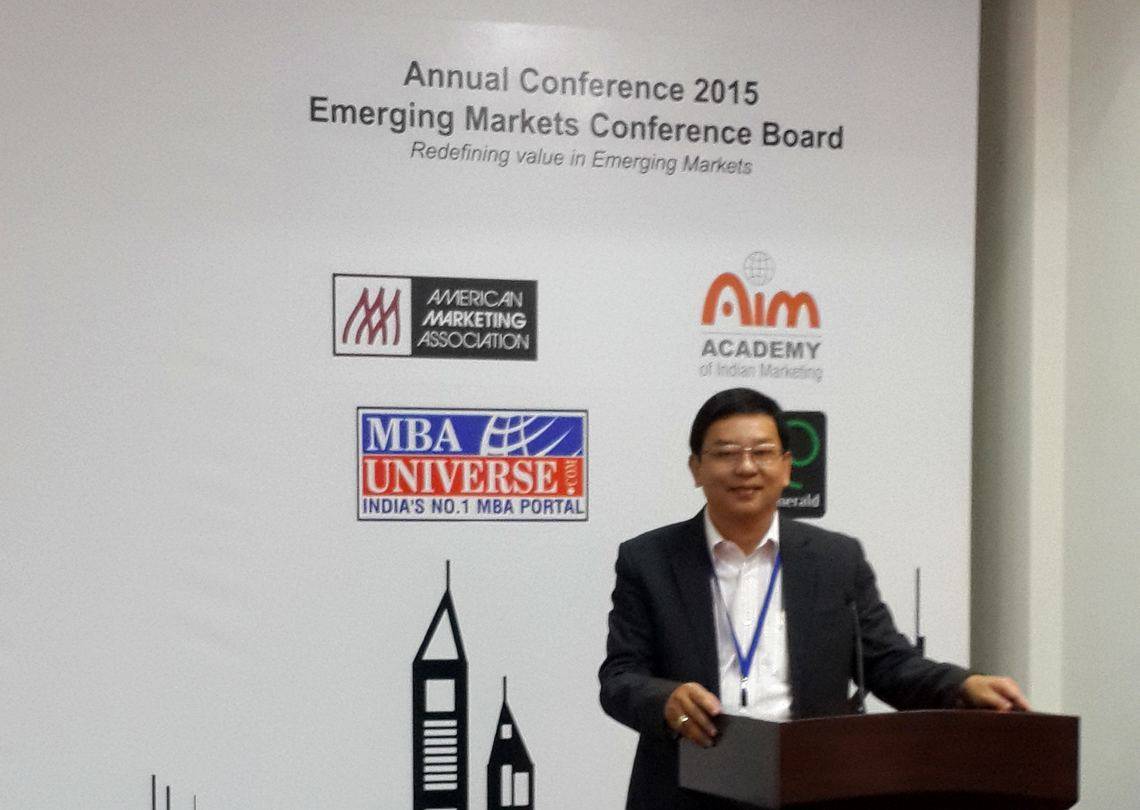
Dr. Phuong Nguyen presenting at the Annual Conference of the Emerging Markets Conference Board, Dubai

Annual Conference of the Emerging Markets Conference Board · Dubai · January 2015

Dubai, January 2015. The Annual Conference of the Emerging Markets Conference Board.

I was midway through a doctoral program at the Sorbonne. I had convictions, not yet certainty.

The dominant thinking that week was Marketing 3.0, Kotler's call to move beyond customer-centricity toward human-centricity. Values. Purpose. The soul of the brand, not just its function. It felt like a destination.

It was actually a departure gate.

In the decade that followed, Kotler kept moving. So did the discipline. 4.0 went where the customer went, digital and omnichannel and always on. 5.0 asked how to use technology in the service of humanity rather than instead of it. The latest version is asking the harder question that this decade requires: in an age of generative AI and hyper-personalization, how does a brand stay legibly human?

Each version did not cancel the previous one. It raised the floor.

The marketers I respect most are not the ones who have arrived at the latest version. They are the ones still asking what the latest version is missing.

This is the move I learned from Henry Mintzberg, more than from any other thinker. Not Mintzberg's specific framework, which is itself now decades old, but the intellectual posture that produced it. The willingness to treat the textbook as a description that may have stopped describing the world.

The textbooks describe what managers should do: they plan, organize, lead, and control. These four verbs were borrowed from a hundred-year-old French industrial framework. They are clean. They are teachable. They are also wrong.

Mintzberg, observing real managers in real organizations across decades of empirical research, found something different. Real managers do not plan in long uninterrupted sessions. They handle a hundred small fragments of work in a single day. They lead through informal communication, much of it verbal, almost all of it under time pressure. They control through attention: choosing, hour by hour, what to notice and what to let go.

The textbook manager is a fiction the curriculum needed in order to be teachable.

The real manager is a more interesting figure: improvisational, fragmented, deeply embedded in relationships, working in conditions of permanent incompleteness.

This matters because the gap between the textbook and the reality is where most management failure lives. A young manager trained on the textbook arrives at the job and finds they cannot do what the textbook described. They conclude they are doing the job wrong.

They are not. They are doing the real job, which the textbook never told them about.

The same gap operates inside graduate education. The MBA student trained on cleanly bounded cases arrives at her own Tuesday afternoon decision and finds that the framework she just mastered is not actually available to her at the moment of choosing. She concludes she has not yet learned the framework well enough. She has. The framework she has learned describes a manager the textbook needed, not the manager she will actually become.

Mintzberg's contribution is not a new framework. It is permission to take the real job seriously.

The Discerning Practice Model rests on this recognition. The Friday Synthesis is not a tool for the manager who plans in long sessions. It is a tool for the professional whose week was fragmented and who needs a fixed fifteen minutes to integrate what the fragments meant. The Decision Hypothesis is not for the textbook conditions of a clean case study. It is for the operator under pressure, with incomplete information, who nevertheless needs to be able, six months later, to learn from what was decided.

What I carry from that Dubai podium is not a framework. It is a posture. The willingness to treat what I have just mastered as the starting point, not the summit.

← Back to all reflections Dr. Phuong Nguyen

The weekly practice I teach my students and coach my managers is free at drpnguyen.com.

REFLECTION 06 Field notes from the AI moment

The credential, the assistant, and what neither can replace

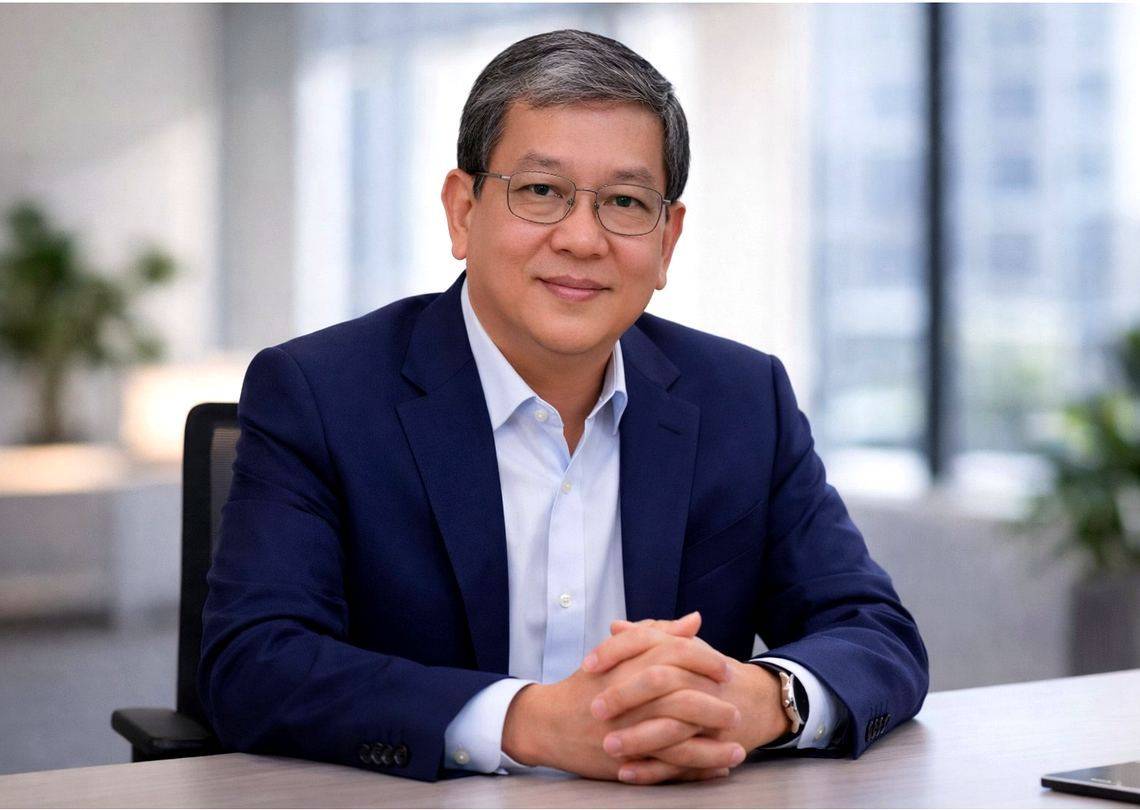
Portrait of Dr. Phuong Nguyen

I have spent thirty years watching what credentials do for people, and what they do not do for them.

The MBA does not produce, by itself, the manager who can decide under pressure. The medical degree does not produce, by itself, the clinician who can sit with a worried parent. The PhD does not produce, by itself, the scholar who can hold a hard question open for the years it takes to answer. The credential, in every case, opens a door. The work that follows the door is what produces the person.

This was true in 1991, when I finished medical school in Hue. It was true in 2008, when I finished an MBA at Maastricht. It was true in 2017, when I defended a doctoral thesis in Paris. The credential never did the work. It signaled that a certain amount of work had been done. The two are not the same.

What is new, in 2026, is that the door now comes with an assistant on the other side of it.

The assistant is patient, articulate, and available at three in the morning. It will draft the strategy memo. It will summarize the case study. It will write the reflection paragraph the program assigns, in serviceable academic prose, in under a minute. A graduate student under deadline, exhausted from a fifty-hour week at work and a Wednesday-night seminar, can submit work that looks adequate without doing the cognitive work the program was designed to extract from them.

A 2025 study by Fan and colleagues randomly assigned university students to learn with or without ChatGPT support. The AI-assisted group produced essays with higher scores. The same group showed no greater knowledge gain or transfer. The authors named the pattern metacognitive laziness: students outsourced the planning, monitoring, and evaluation phases of learning to the tool rather than scaffolding their own thinking with it. A 2025 study of postgraduate students in Hong Kong, by Yao and colleagues, found the same pattern in academic writing. The work submitted was acceptable. The student behind the work was not changed by producing it.

This is the failure mode the credential cannot defend against. A degree produced under metacognitive laziness is, on paper, indistinguishable from a degree produced through actual cognitive labor. The transcript looks the same. The diploma looks the same. The graduate looks the same, until they have to make a decision their AI is not in the room for.

The Discerning Practice Model addresses this directly, but not by trying to outrun the assistant. It addresses it by being built around precisely the cognitive work the assistant cannot do for the student. Writing from memory rather than from notes. Predicting an outcome before consulting any tool. Naming a principle in your own words and pairing it with the situation where the principle would mislead you. Producing a Friday Synthesis of a week the student actually lived, not of a week the tool can describe in general.

The practices are AI-resistant by construction, not by accident. An assistant that drafts the synthesis destroys the synthesis. A tool that produces the principle removes the part of the principle that compounds. The architecture refuses, structurally, to let the work be ghostwritten.

What the practices preserve is the one thing neither the credential nor the assistant can supply. The dated record, in your own words, of how your judgment actually changed. That record is what survives. That record is what compounds. That record is what makes the difference, ten years on, between a graduate who can recognize their own thinking and a graduate who cannot quite remember whose voice the document is in.

The credential gets you through the door.

The assistant will type whatever you ask of it.

What neither can do is be the person on the other side.

← Back to all reflections Dr. Phuong Nguyen

The weekly practice I teach my students and coach my managers is free at drpnguyen.com.

10 Notes & Citations

The intellectual lineage.

The Discerning Practice Model rests on six classical pillars of learning theory together with the self-regulated learning tradition, and on a body of recent empirical work that has reaffirmed their relevance. Both layers are listed below.

The classical foundations

Argyris, C., & Schön, D. A. (1978). Organizational learning: A theory of action perspective. Addison-Wesley. The foundational distinction between single-loop and double-loop learning, central to the Friday Synthesis practice.
Bandura, A. (1997). Self-efficacy: The exercise of control. W. H. Freeman. The mechanism by which deliberately built capability becomes confidence and then becomes performance.
Kolb, D. A. (1984). Experiential learning: Experience as the source of learning and development. Prentice Hall. The original four-stage cycle. The structural ancestor of the five-practice model on this site.
Lave, J., & Wenger, E. (1991). Situated learning: Legitimate peripheral participation. Cambridge University Press. Learning as participation in real practice. The reason the model treats the workplace as the principal site where program ideas are tested, not as a distraction from study.
Mezirow, J. (1991). Transformative dimensions of adult learning. Jossey-Bass. The theory of how mental frames change in adulthood, and why they so often do not.
Mintzberg, H. (1973). The nature of managerial work. Harper & Row. The original observational study of what managers actually do, and the empirical ancestor of Mintzberg (2009).
Mintzberg, H. (2009). Managing. Berrett-Koehler. The most empirically grounded description of what managers actually do.
Nonaka, I., & Takeuchi, H. (1995). The knowledge-creating company: How Japanese companies create the dynamics of innovation. Oxford University Press. The dynamic between tacit and explicit knowledge that underlies the Friday Synthesis practice, and the externalization of professional knowledge that the thesis stage of the graduate journey depends on.
Revans, R. W. (1980). Action learning: New techniques for management. Blond and Briggs. The principle that good questions accelerate development more than good answers, embedded in the Decision Hypothesis.
Schön, D. A. (1983). The reflective practitioner: How professionals think in action. Basic Books. The case for reflection as professional discipline rather than personal habit.
Senge, P. M. (1990). The fifth discipline: The art and practice of the learning organization. Doubleday. Personal mastery, mental models, and the systems view of organizational development.

Recent evidence

Panadero, E. (2017). A review of self-regulated learning: six models and four directions for research. Frontiers in Psychology, 8, 422. The self-regulated learning tradition: setting goals, monitoring progress, regulating strategies, evaluating outcomes. These are precisely the functions at risk when a student under pressure hands the thinking to an assistant.
Farnese, M. L., Barbieri, B., Chirumbolo, A., & Patriotta, G. (2019). Managing knowledge in organizations: a Nonaka's SECI model operationalization. Frontiers in Psychology, 10, 2730. Specifies externalization as the mode in which tacit knowledge is made codifiable through reflection. The artifact structure of the model is built on it.
McClain, A. L. (2024). New developments in transformative learning. New Directions for Adult and Continuing Education, 2024(184), 20–29. Five decades of transformative learning research reviewed. Identifies reflection, dialogue, trust, and time as the recurring enabling conditions. Without structured reflection, disorientation stays confusion.
Yan, L., Greiff, S., Teuber, Z., & Gašević, D. (2024). Promises and challenges of generative artificial intelligence for human learning. Nature Human Behaviour, 8(10), 1839–1850. The boundary stated plainly: a generative system cannot have the student's professional experience, bear responsibility for a workplace decision, or self-regulate the student's learning.
Fan, Y., Tang, L., Le, H., Shen, K., Tan, S., Zhao, Y., Shen, Y., Li, X., & Gašević, D. (2025). Beware of metacognitive laziness: effects of generative artificial intelligence on learning motivation, processes, and performance. British Journal of Educational Technology, 56(2), 489–530. Students supported by a generative assistant improved essay scores but showed no greater knowledge gain or transfer. The authors name the pattern metacognitive laziness: the offloading of planning, monitoring, and evaluation.
Xu, X., Qiao, L., Cheng, N., Liu, H., & Zhao, W. (2025). Enhancing self-regulated learning and learning experience in generative AI environments: the critical role of metacognitive support. British Journal of Educational Technology, 56(5), 1842–1863. The converse finding. Students given metacognitive support in AI-rich environments strengthen their self-regulation; unsupported students risk losing it. Scaffolding, not abstinence, is what separates the two.
Bastani, H., Bastani, O., Sungu, A., Ge, H., Kabakçı, Ö., & Mariman, R. (2025). Generative AI without guardrails can harm learning: evidence from high school mathematics. Proceedings of the National Academy of Sciences, 122(26), e2422633122. Unrestricted assistant access raised assisted practice scores by 48 percent. Once access was removed, those students scored 17 percent worse than peers who had never used it. A constrained version of the same assistant did not produce the drop.
Dell'Acqua, F., McFowland, E., III, Mollick, E., Lifshitz, H., Kellogg, K. C., Rajendran, S., Krayer, L., Candelon, F., & Lakhani, K. R. (2026). Navigating the jagged technological frontier. Organization Science, 37(2), 403–423. A preregistered field experiment with 758 consultants. Inside the system's capability frontier, assisted work outperformed. On a task designed to fall outside it, correctness dropped by 19 percentage points.
Yurt, E., & Kušci, I. (2026). Factors influencing critical thinking during AI use among university students: the mediating effects of epistemic laziness and metacognitive weakness. Current Psychology, 45, 67. Suggests the effect of AI on critical thinking runs through epistemic laziness and metacognitive weakness rather than through the tool itself.
A note on the evidence. The empirical base around metacognitive laziness is emerging rather than settled, and several studies are limited by sample size, context, or design. The argument here does not rest on maximal claims about AI harm. The classical synthesis carries the conceptual weight; the recent work sharpens where the practices need to bite.

Fifteen minutes this Friday.

Four questions, in your own words, on paper or in a document of your own. One prompt arrives by email every Friday at 07:00 GMT+7. Fifteen minutes to start. Thirty when you have them. The practice is free and stays free.

Start the free weekly practice
11 Contact

Get in touch.


For correspondence on the Discerning Practice Model, speaking and teaching invitations, research collaboration, or thoughtful questions from readers.

A short note about who you are and what is on your mind is the fastest way to a reply.

What this site is.

This site exists to share knowledge, insights, and the learning that comes from thirty years at the intersection of commercial leadership and academic research. The weekly practice I teach my students and coach my managers is free at drpnguyen.com.

Welcome:

  • Program directors and faculty considering the model for their cohorts
  • Executive education directors looking for a one-day course on judgment and AI
  • Anyone in the arc of a graduate degree writing the Friday Synthesis, and anyone wondering whether to start
  • Working professionals and managers applying the practices
  • Speaking invitations from MBA programs and industry events
  • Research collaboration and doctoral mentorship
  • Editorial and media requests
  • Thoughtful questions from readers
Start the free weekly practice

Privacy

Your name and email address are stored with the email service that sends the Friday prompt and are used only for what you ticked at sign-up. The two boxes are recorded separately. Nothing is sold or shared. Every email has an unsubscribe link, and you can ask for your details to be deleted at any time by writing to phuong@drpnguyen.com. Personal data is handled in line with Vietnam’s personal data protection rules.