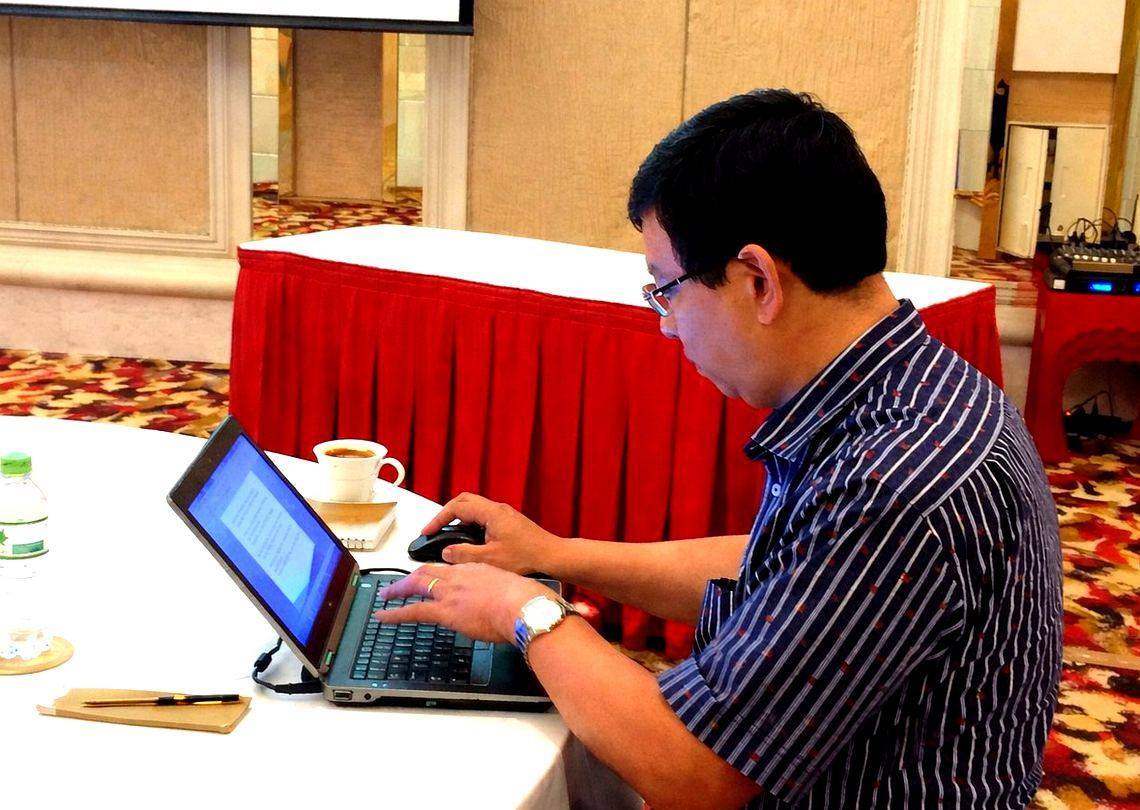
Between sessions, working through a synthesis · Vietnam
It is the second day of a two-day conference in a hotel ballroom in the south of Vietnam, and it is twenty minutes before the afternoon sessions resume. The room is empty. The staff are in the back, resetting microphones. My coffee has gone half cold. My notebook sits closed beside the laptop, with the pen across it.
The synthesis is overdue by a day. I had meant to write it yesterday. I will write it now.
I open the document. The cursor blinks.
The first three prompts are not the hard ones. What happened this week, I can write quickly: there were two long meetings about a brand we are repositioning, a difficult conversation with a senior team member, and a decision I had to make on Tuesday that I am still not sure was the right one. What assumption did I make that turned out wrong, I can also write, though more slowly. The Tuesday decision was the one. I had assumed the team would resist the change. They did not resist. They were quietly relieved, which means I had been carrying a story about them that was not accurate, possibly for months.
What general principle does this illustrate. I write a sentence I have written before, in slightly different words, three or four times across the previous Fridays. Resistance is sometimes a story the leader is telling, not a property of the team.
I look at the sentence for a moment. It is true. It is also the kind of true sentence that, by itself, will not change anything I do on Monday morning.
The fourth prompt is sitting there, and it is the one I want to skip.
Where would this principle mislead me.
This is the prompt that takes the longest. It is also the prompt I have, a few times in earlier weeks, written something glib for, just to get to the end of the document. It would mislead me if I assumed teams never resist, I might write, which is the kind of sentence that satisfies the form of the practice without satisfying its purpose. The boundary statement is supposed to be the point at which the principle stops being a slogan and becomes usable, and a glib boundary statement leaves the principle a slogan.
So I sit with it for a minute. Then I write something more honest. This principle would mislead me with the team I worked with three years ago, where the resistance was real, sustained, and rooted in their own correct read of a situation I had misjudged. If I generalize from this Tuesday, I will start hearing relief where there is, in fact, careful disagreement.
I look up. The staff are setting the front of the room. Two delegates have wandered back in. I have about four minutes. I save the document with the date in the filename, close the laptop, and slide it into my bag.
I know two things about this synthesis that I did not know fifteen minutes ago. I know that I have been carrying an inaccurate story about my current team. And I know the conditions under which the new principle I just wrote would betray me. Neither of those would have surfaced if I had spent the same fifteen minutes scrolling through email or lingering over the empty coffee.
The practice is not always done at the desk where it should be done. It is done in hotel function rooms. It is done in airport lounges. It is done on the train back from a meeting, on the morning of the day after the missed Friday. The practice is not the room. The practice is the discipline of writing the fourth prompt honestly, wherever the laptop happens to be open.
Twelve weeks of this is one Operating Manual revision and a small library of dated honesty.
A year of this is a thesis.
A career of this is a different kind of career.
The weekly practice I teach my students and coach my managers is free at drpnguyen.com.
Four questions, in your own words, on paper or in a document of your own. One prompt arrives by email every Friday at 07:00 GMT+7. Fifteen minutes to start. Thirty when you have them. The practice is free and stays free.
Start the free weekly practice