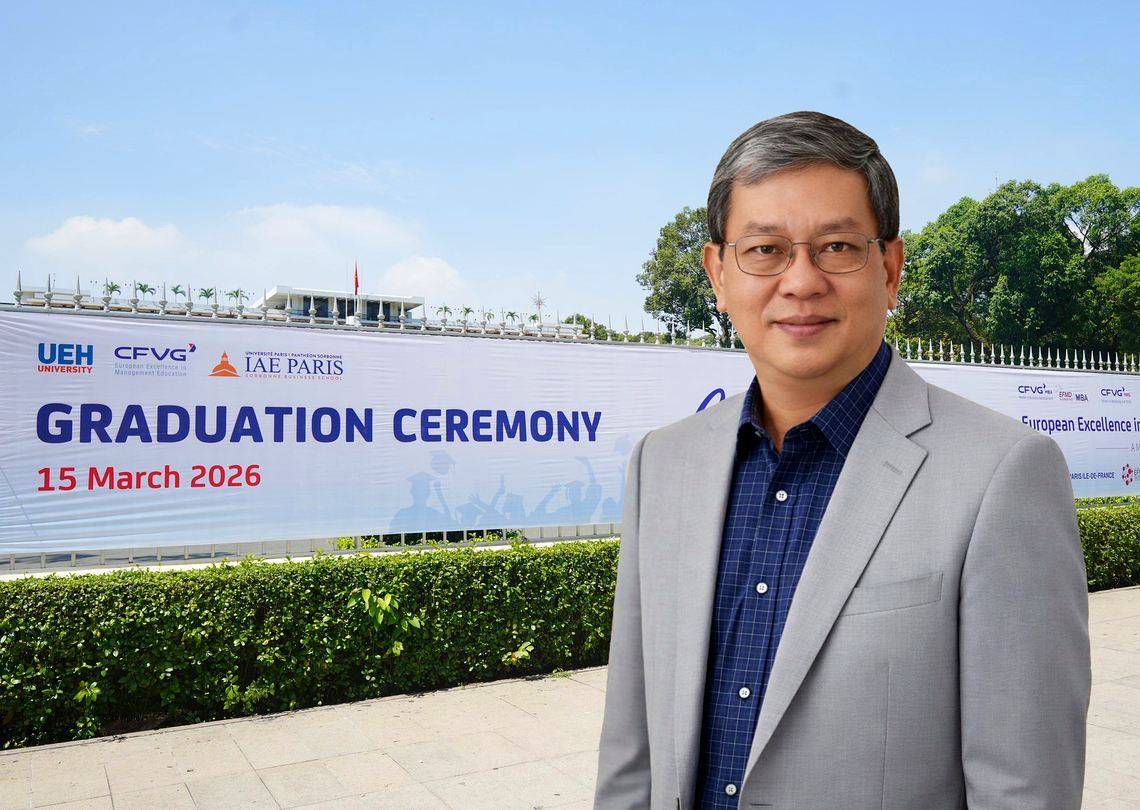
CFVG Graduation Ceremony · Ho Chi Minh City · 15 March 2026
The photograph is from the CFVG Graduation Ceremony on 15 March 2026, in Ho Chi Minh City. I had stood through eight of these by then, including a few I remember more vividly than others. This was the ninth.
When I first walked into a CFVG classroom in May 2017, I thought I knew why I was there. I had more than two decades of country leadership behind me. I had launched brands, run P&Ls, built and rebuilt teams across Vietnam, Cambodia, and Myanmar. I assumed I was being asked to bring that experience into the room, a practitioner among scholars translating frameworks into the specifics of the local market.
That was not what teaching turned out to be.
What teaching turned out to be was watching, with care, while a particular kind of failure happened, again and again, to people who had every reason not to fail. The students who came to CFVG were not novices. They were senior managers, country heads, finance directors, people with fifteen and twenty years of operating experience. They could read a case. They could recognize a framework. They could explain, in the discussion section, exactly what Mintzberg or Kotler or Porter would say about the situation in front of them.
And then, the following week, they would describe a real decision they had made at work, and the framework would have left no trace.
Not because they had forgotten it. They could still recite it on demand. The framework simply had not been available to them at the moment of decision. It lived in the seminar room and not in the office. By Monday morning, they were operating from the same instincts they had walked in with.
I had thought, at first, that this was a problem of individuals. Some students were better at integration than others, and the rest needed time. After the third cohort, I began to suspect it was not about the individuals. After the fifth, I was certain. The pattern was too consistent. The same brilliant managers, with no obvious deficit of intelligence or motivation, were producing the same gap between framework recognition and framework operationalization.
It was not a problem of individuals. It was a problem of method.
The graduate education we were giving them (the lectures, the cases, the readings, the exams) was almost perfectly designed to produce framework recognition. It was almost perfectly silent on framework operationalization. We were assessing what was easy to assess, and assuming the harder thing would happen on its own. It did not happen on its own. The credential was being conferred on a transformation that was, in many cases, not actually taking place.
What we now call the Discerning Practice Model is the answer those nine cohorts taught me to construct. The Friday Synthesis. The Decision Hypothesis. The Operating Manual. The five practices were not invented. They were reverse-engineered from the gap between what the program promised to do and what, year after year, it was actually doing.
Standing in front of the graduation banner on 15 March 2026, I watched the most recent cohort take their seats, and I understood graduation differently than I had at the first ceremony. Graduation is not the moment a credential is conferred. Graduation, when the work has been discerning practice, is the moment a person walks out of the program with a dated record, in their own words, of what they decided, what they expected, and what really happened.
Most graduations are not that.
The work of the next decade is to make more of them so.
The weekly practice I teach my students and coach my managers is free at drpnguyen.com.
Four questions, in your own words, on paper or in a document of your own. One prompt arrives by email every Friday at 07:00 GMT+7. Fifteen minutes to start. Thirty when you have them. The practice is free and stays free.
Start the free weekly practice