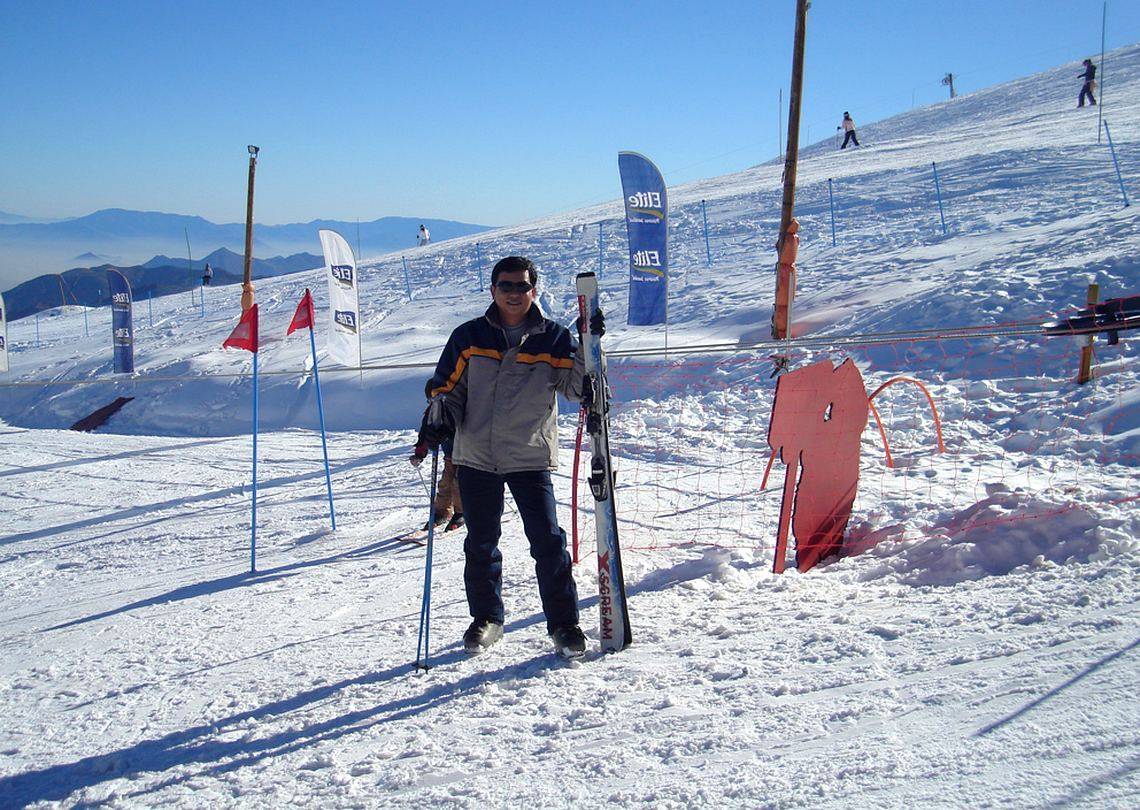
La Parva · Chile · May 2008
There is a photograph of me from May 2008, on the slopes of La Parva in Chile.
In the photograph, I am holding ski poles. The light is good. The pose is confident. Anyone looking at the image would assume the man in it knew what he was doing.
I had read the equipment manual the night before. I had quietly watched the beginner instructors that morning. I had skied perhaps fifty meters before the photograph was taken.
What makes me smile about that photo now, almost twenty years later, is what the photo did not keep. It did not keep the wobbliness. It did not keep the quiet conversation I had with myself about being forty-one and starting something I did not yet do well. Photographs preserve confidence. They do not preserve the practice that produced it, or the practice that was still missing.
I think about that photo often when I talk to my students, working managers in the middle of a career and a degree, about plateaus.
Most people who plateau in their thirties or forties believe they need more knowledge to move forward. So they enroll in another course. They read another book. They start a master's degree, and keep the job. The plateau remains.
This is the central misdiagnosis of the plateau. I see it most clearly in working master's students who finish their first year and quietly notice, when no one is watching, that the framework they can recite has not yet changed how they made yesterday's decision at work.
The plateau is rarely a knowledge problem. It is a practice problem.
The habits that built your early career (execution speed, technical fluency, willingness to work hard) are not the habits that build judgment. Early-career success rewards doing more of what is asked. The next stage, whether you reach it through promotion or through a graduate program, rewards a different question: doing what is asked, while simultaneously building the judgment that allows you to be asked harder things.
Most professional development is event-based. You attend the workshop, return to your desk, and, in my observation, most of what you learned is gone within a few months. The same pattern shows up in graduate education. You finish the course, hand in the assignment, and the work makes no observable change to how you operate on Monday morning. The pattern has been documented in the experiential learning literature for more than forty years. It is universal. It is the reason most professional development, including most graduate education, produces less than it promises.
The Discerning Practice Model replaces events with practices.
A practice is not a lesson. It is a short, fixed, repeated activity done on a known cadence. Fifteen minutes once a month for the Stretch Inventory. Fifteen minutes every Friday for the Friday Synthesis, thirty when you have them. Four lines on a card before any meaningful decision. None of this is heroic. All of it is compounding.
The truest part of growth, I have come to believe, begins from steps that are still wobbly. The student who installs these practices in the first term has, by the time of the thesis, a year of dated material no other student in the class can produce. The one who installs them late, in the thesis year, still begins to grow again at a stage where many classmates have stopped.
A book is something you finish.
A practice is something you keep.
The careers that compound, and the degrees that change the people who earn them, belong to the ones who have understood the difference.
The weekly practice I teach my students and coach my managers is free at drpnguyen.com.
Four questions, in your own words, on paper or in a document of your own. One prompt arrives by email every Friday at 07:00 GMT+7. Fifteen minutes to start. Thirty when you have them. The practice is free and stays free.
Start the free weekly practice